
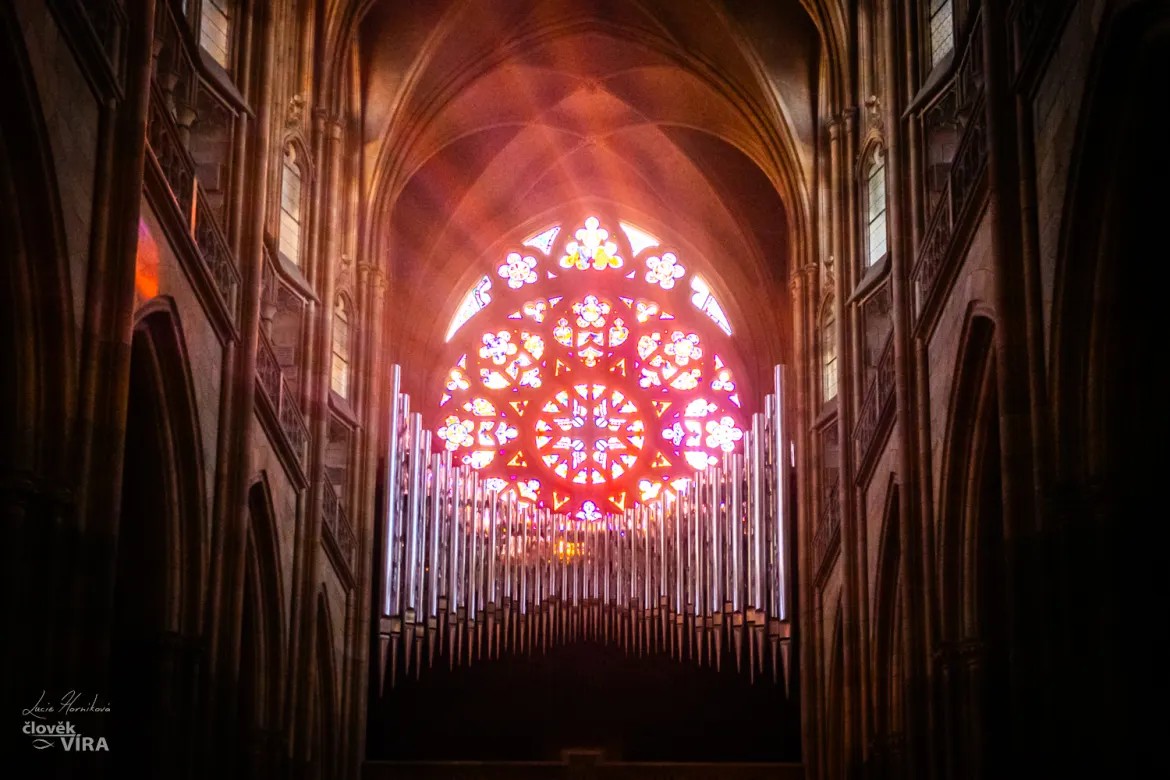
The New Organ in St. Vitus Cathedral in Prague – A Visual and Acoustic Masterpiece
Generations of church musicians, worshippers, and priests have been waiting for this moment: on 15 June, the new organ of St. Vitus Cathedral in Prague was inaugurated. During the solemn Mass on Monday, Archbishop Stanislav Pribyl described the instrument as the "new voice of the cathedral," speaking not through words, but through music directly to people's hearts. The organ, featuring 121 stops, 5,755 pipes, and two consoles, was blessed by Archbishop Emeritus Jan Graubner. During the three-hour celebration, works by Antonín Dvořák, George Frideric Handel, Camille Saint-Saëns, and Joseph Haydn were performed. The ceremony also symbolically marked the completion of the nearly seven-century-long construction of the Czech Republic's most important church at Prague Castle.
The organ, specially designed for the extraordinary acoustics of St. Vitus Cathedral, was built in the workshop of organ builder Gerhard Grenzing in El Papiol near Barcelona. Grenzing described the project as one of the highlights of his professional life and called it a true work of art serving music, the liturgy, and the cathedral's architecture. The organ façade was conceived by Jan von Hassel. Its external design was created through mutual inspiration between Grenzing's design team and designer Peter Olah. Both explained: "We did not want to create an object that dominates the cathedral, but one that enters into dialogue with it." The seemingly floating pipes are complemented by around 180 elements made of Bohemian crystal.
The initiative to build the instrument goes back to Cardinal Dominik Duka (1943–2025), who passed away six months ago. Shortly after becoming Archbishop of Prague in 2010, Duka began considering a comprehensive enhancement of the cathedral. After the lighting had been renewed and the chancel restored, he advocated the construction of a representative cathedral organ. The Cardinal set the project in motion and launched a fundraising campaign.
More than 12,000 donors contributed, financing the majority of the nearly €5 million project. The decisive implementation phase inside the cathedral took place during Jan Graubner's tenure as Archbishop of Prague from 2022 onward. The sound of the new organ had already been heard during Cardinal Duka's funeral last November.
The history of organ music in St. Vitus Cathedral dates back to the 13th century. The first reliable record of an organ comes from the reign of King Ottokar II Přemysl. At that time, the dean of the cathedral chapter commissioned a new organ for 26 marks of silver. The instrument was comparatively small and was partly played with fists or elbows. During the reign of Charles IV, another organ was probably built.
A particular highlight was the so-called "Imperial Organ," commissioned by Emperor Ferdinand I and completed in 1570. It was played not only during church services but also at the coronations of Bohemian kings. This organ was destroyed during the Prussian siege of Prague in 1757. Its successor, the Baroque organ built by Johann Anton Gartner with 2,619 pipes, was completed in 1765. Parts of this instrument have survived to the present day. Although a large new west organ was planned after the completion of St. Vitus Cathedral in 1929, financial resources were lacking. Instead, a temporary organ was installed on the old north gallery in 1930. It proved inadequate for the vast interior of the cathedral. The west gallery, intended for a representative cathedral organ, remained empty for more than 90 years. Only with the inauguration of the new Grenzing organ has the original vision finally been fulfilled. (Michael Grüber)
Photo Gallery
Further Links
Complete live broadcast of the organ inauguration
https://katedrala.tv/detail/642
News TV programme
https://vimeo.com/1203529068/c870abb52d
Gala concert for the new St. Vitus organ
https://vimeo.com/1203264569
15th International Organ Festival in St. Vitus Cathedral
https://www.varhannifestival.cz/en
The St. Vitus Organ
https://apha.cz/akce/slavnostni-inaugurace-novych-svatovitskych-varhan-a-svatovitsky-oktav/
Photos by Martin Doering
https://die-orgelseite.de/bilder/sets/CZ_Praha_Katedrala.htm
A New Organ for St. Vitus Cathedral in Prague – Information
On 15 June 2026, the new organ of St. Vitus Cathedral in Prague was inaugurated. Built by the workshop of Gerhard Grenzing in El Papiol (Barcelona), it was completed after more than three years of construction, followed by over six years in storage in the assembly hall. During that period, the Grenzing team continued building other commissioned instruments, including a four-manual organ with a 16-foot façade and Rückpositiv for Stockholm.
The completion of this instrument also symbolically marks the completion of the cathedral itself, more than seven centuries after construction began, representing one of the most significant artistic, cultural-historical, and musical events in Europe in recent years.
The Prague organ is one of the largest mechanical organs ever built by the Grenzing workshop and one of the largest newly completed instruments currently in existence. The project was awarded through an international competition, and its realization was made possible through a foundation established specifically for the project, funded by contributions from companies, patrons, and an extensive network of donors as part of an unprecedented fundraising campaign.
The Grenzing workshop's goal was to match the extraordinary scale of the cathedral with an equally impressive sound: its vast Gothic architecture, completed in modern times, with a nave approximately 120 metres long and 33 metres high. The instrument was conceived with energy and poetry, not merely with "power."
The organ's musical concept is based on a specific acoustic study of the cathedral, including tests with real pipes placed in different locations throughout the building. These experiments enabled the Grenzing team to predict how the sound would behave within the space and to prepare for the highly complex voicing process.
The instrument features four manuals, 121 stops (including extensions), and two consoles—one mechanical and one mobile—with a total of 5,755 wooden and metal pipes, the largest of which measures ten metres in height. The organ itself is approximately 13 metres high, 13 metres wide, and 6 metres deep, weighing more than 40 tonnes. One of its most remarkable features is the fully speaking 32-foot façade pipes from the very first F, a unique achievement in the history of the Grenzing workshop.
More than thirty different wood species were used in its construction, together with natural materials such as leather and felt for the bellows and internal mechanisms. The façade also incorporates elements of Bohemian crystal, paying tribute to one of the Czech Republic's most iconic craft traditions.
From the outset, the project included one essential requirement formulated by Cardinal Dominik Duka, the project's initiator: the view of the great rose window from the altar had to remain unobstructed. This led to a unique design in which the free-standing façade follows the geometry of the rose window, delicately tracing the curve of its lower semicircle. Rather than dominating the interior, the façade enters into a direct dialogue with one of the cathedral's defining architectural features.
The façade pipes, especially the prominent 32-foot pipes that speak fully from the first F, are cantilevered and appear to hang from the instrument's internal structure. Free from any visible supports, they resemble floating jewels against a dark background that enhances both their presence and their interaction with light. This arrangement creates an impression of lightness and weightlessness, transforming the façade into a living work whose appearance changes throughout the day.
The pieces of Bohemian crystal placed between the pipes reflect the desire to honour the country's renowned glass and crystal tradition. Their presence gives the instrument a poetic yet contemporary character while showcasing the excellence of Czech craftsmanship.
Designer Jan von Hassel proposed the use of Bohemian crystal elements between the pipes as a tribute to the country's glassmaking tradition. Their presence lends the instrument both a poetic and a contemporary dimension while expressing the outstanding quality of Czech craftsmanship.
As early as October 2019, the fully assembled organ was presented at the Grenzing workshop to the project commission, patrons, and Cardinal Dominik Duka during an event featuring several concerts.
In 2025, the instrument was transported to its permanent location in the cathedral, where it underwent an intensive ten-month installation process requiring exceptional technical precision and continuous coordination among all those involved. At the same time, the voicing of the organ was carried out in constant dialogue with the building's acoustics and spiritual atmosphere—while temperatures dropped to as low as 4°C (39°F)!
The new organ in St. Vitus Cathedral in Prague – a visual and acoustic masterpiece!